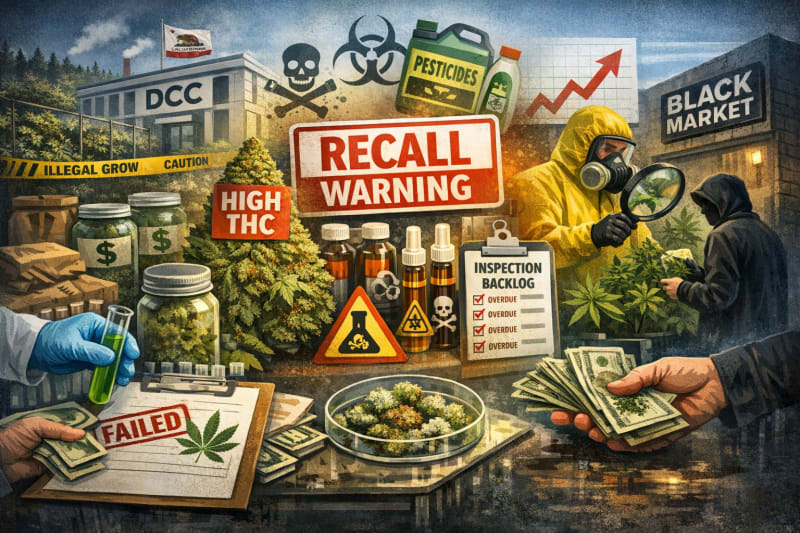
As of February 26, 2026, California’s cannabis testing regime — overseen by the California Department of Cannabis Control (DCC) — continues to face structural challenges despite ongoing reform efforts.
Under current law, licensed laboratories must test cannabis products for:
- Cannabinoid potency (THC, CBD, etc.)
- Contaminants (pesticides, heavy metals, residual solvents, mold, mycotoxins)
- Accurate labeling and packaging compliance
Yet systemic weaknesses — including “lab shopping,” enforcement delays, inconsistent testing protocols, and regulatory fragmentation — have allowed contaminated products and inflated potency claims to reach consumers. The result: a surge in recalls, diminished industry credibility, and continued strength of California’s illicit cannabis market.
While new legislation in the 2026 session aims to close critical gaps, full implementation remains pending.
1. Lab Shopping & Testing Inconsistencies
One of the most significant weaknesses in California’s system is the privatized testing structure.
How Lab Shopping Works
Producers are allowed to:
- Select their own testing lab
- Pay the lab directly
- Resubmit failed batches to different labs
This creates a financial incentive for labs to produce favorable results — particularly inflated THC levels or contaminant passes — to retain business.
Independent analyses suggest:
- Up to 87% of products show labeling inaccuracies
- Overstated THC potency is common
- Testing variability between labs remains substantial
Unlike states with centralized or state-operated reference labs, California relies almost entirely on private laboratories. As of April 2025, only 16 of 42 cannabis-regulating states have implemented or planned state reference labs for oversight.
Without uniform reference standards and cross-validation enforcement, testing thresholds and detection methods can vary significantly from lab to lab.
Impact:
- Inflated potency claims
- Contaminants slipping through
- Erosion of consumer trust
2. Pesticide & Contaminant Detection Gaps
California mandates testing for 66 pesticides, one of the strictest lists in the country. However, coverage gaps remain.
Key Issues
- Illegal or untested chemicals (e.g., chlorfenapyr, carbofuran) have been detected outside the required screening panel.
- Vape products pose unique risks: heating can convert certain residues into toxic byproducts.
- Expanded independent testing (2024–2025) identified over 290 pesticide residues, vitamin E acetate in some products, and additional unregulated contaminants.
Meanwhile, other states test for far fewer substances (e.g., Colorado tests for only 15 pesticides), highlighting national inconsistency.
In mid-2025, DCC updated pesticide residue levels to reduce unnecessary batch failures. However, enforcement remains challenged by limited staffing, the scale of unlicensed grows, and the $534 million in illegal cannabis seized in 2024 alone.
Result: Testing panels do not always match real-world contamination risks.
3. Recall & Embargo Surges
The most visible indicator of systemic weakness has been the explosion in recalls.
Data Trends
- 800% increase in recalls from 2023 to 2024
- 481 embargoes issued in 2024
- 34 recalls covering 444 products in Q2 2025 alone
Common causes include:
- Incomplete or improper testing
- Contaminant detection failures
- Child-attractive packaging violations
- Label inaccuracies
A 2025 state audit found:
- DCC inspected fewer than half of licensees annually since 2022
- Staffing shortages limited proactive oversight
- Repeat offenders were not consistently tracked
- Escalating penalties were inconsistently applied
This reactive model means tainted products can remain on shelves for months before enforcement action.
4. Insufficient Local Protections
California’s local jurisdictions play a significant role in cannabis oversight — but protections vary widely.
2025 Scorecard Findings
- Average public health safeguard score: 23/100
- Only 14 of 539 localities restrict ultra-high-potency products, youth-appealing features (e.g., flavored vapes), or certain product marketing tactics
State-level smoke-free expansions and potency caps have stalled. As youth use and high-potency product concerns rise, regulatory gaps remain largely unaddressed.
5. Broader Structural Challenges
Beyond laboratory flaws, the cannabis ecosystem faces systemic pressures.
Black Market Dominance
High taxes and compliance costs contribute to an illicit market supplying approximately 60% of cannabis sales in California. Illicit products are untested, often contain contaminants, and undermine legal operators who invest in compliance.
Scientific & Regulatory Inconsistency
Reforms in employment testing (e.g., ignoring non-psychoactive metabolites) show progress in science-based policy — but broader cannabis science integration remains inconsistent across regulatory domains.
2025–2026 Reform Efforts
Despite these issues, reforms are underway.
2025 Administrative Actions
The DCC:
- Increased investigations into non-compliant products
- Proposed updated sanitation standards
- Added 13 inspection staff (bringing total to 55)
- Updated warning labels (July 2025)
- Required consumer education brochures at retail (March 2025)
These measures improve transparency but do not fundamentally restructure testing oversight.
2026 Legislative Proposals
AB 1965
- Revises sampling procedures
- Allows structured retesting
- Enables off-shelf compliance testing
- Mandates lab performance evaluations
- Targets lab shopping vulnerabilities
AB 1826
- Establishes due process procedures for recalls/embargoes
- Sets evidence and timeline requirements
- Clarifies regulatory authority
These bills build on stalled 2025 reform efforts such as AB 1027.
What Experts Say Is Still Needed
Industry analysts and public health advocates emphasize:
- Establishment of a state-run reference laboratory
- Cross-lab calibration standards
- Transparent potency verification
- Expanded contaminant panels
- Increased inspection funding
- Harmonized national testing standards
Without structural reform, enforcement will remain reactive and inconsistent.
Why This Matters for Consumers
Testing gaps affect:
- Product safety
- Label accuracy
- Trust in licensed dispensaries
- Long-term public health
When legal products fail to meet testing integrity expectations, consumers may turn to the illicit market — worsening the very safety issues regulation is meant to solve.
Final Outlook (2026)
California’s cannabis testing system is improving — but remains structurally fragile.
While DCC enforcement has increased and new bills show promise, meaningful reform will likely require:
- Centralized oversight
- Stronger lab accountability
- Proactive inspection funding
- Unified scientific standards
Until then, testing variability, recall surges, and enforcement delays will continue to challenge consumer confidence and industry stability.